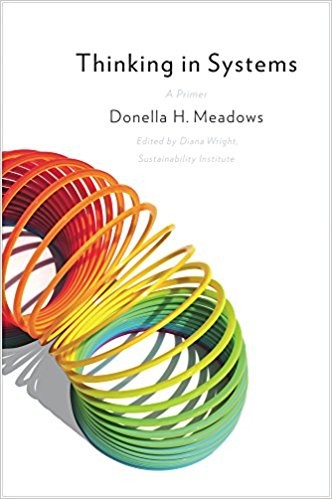

Stocks, flows, feedback and the structures behind recurring problems.
Introduction
Some books give you useful ideas. Others give you a different way of seeing the world. Thinking in Systems belongs in the second category.
Donella Meadows argues that the events we notice are usually produced by structures beneath them. Missed targets, recurring delays and failed interventions are rarely isolated problems; they emerge from systems of stocks, flows, feedback loops, incentives and delays. In that sense, the book occasionally feels like a management version of Douglas Adams’ Dirk Gently, where seemingly unrelated events turn out to be connected through what Dirk calls the fundamental interconnectedness of all things. Meadows is rather more rigorous about it, but the instinct is similar: before treating something as an isolated event, look at what it is connected to.
The book is mainly an introduction to system dynamics, one influential branch of systems thinking. System dynamics focuses on how feedback, accumulation and delay create behaviour over time, but it is not the whole field. Systems thinking also includes approaches concerned with complexity, organisational learning, differing perspectives, cybernetics, power and adaptation. Meadows provides one particularly useful lens rather than a complete map of systems thinking.
Synopsis
Meadows begins by defining a system as a set of interconnected elements organised around a purpose. She then introduces stocks and flows. A stock is something that accumulates, such as inventory, money, employees, technical debt or trust, while flows increase or reduce that stock. Recruitment increases workforce capacity, attrition reduces it, development adds functionality and technical debt gradually reduces the ability to change a product safely.
Stocks create inertia because they take time to build and time to reduce. This explains why many organisational changes produce delayed results, and why leaders often become frustrated when changing an input does not immediately alter the outcome. The book then moves into feedback loops. Reinforcing loops amplify change, while balancing loops attempt to move a system towards a target. Real systems contain many loops operating at the same time, often with significant delays between cause and effect, producing familiar patterns such as overshooting, oscillation, policy resistance and unintended consequences.
Later chapters examine recurring system traps, including escalation, shifting the burden, success to the successful and tragedy of the commons. Meadows ends by considering leverage points: places where relatively small changes can alter the behaviour of the wider system.
Why I Read It
I first read Thinking in Systems around fifteen years ago. At the time it gave me a vocabulary for ideas I had encountered but had not yet connected into a coherent framework. Reading it again now, with considerably more experience in product management, logistics, optimisation and organisational change, many of those ideas feel even more relevant.
In these environments, problems rarely belong neatly to one component. A planning failure might look like an algorithm problem but actually originate in poor data, conflicting objectives, unrealistic constraints or incentives that encourage users to work around the system. Improving one metric can make another worse, and removing one bottleneck can simply move the problem somewhere else. This is where the Dirk Gently comparison works surprisingly well: the obvious explanation is often too local, and the interesting part is understanding the web of relationships producing the visible event.
Returning to Meadows also reinforced something that is easy to forget when talking about systems thinking: system dynamics is only one branch of the wider discipline. Stocks, flows, feedback loops and delays are powerful tools, but other traditions focus more on interpretation, organisational learning, complexity, communication and differing views of what the system actually is.
Key Takeaways
Structure Drives Behaviour
Repeated outcomes are usually evidence of an underlying structure. When teams repeatedly miss deadlines, the problem may not be motivation or individual performance. It may be excessive work in progress, unstable priorities, hidden dependencies or incentives that reward starting work rather than finishing it. Changing the people without changing that structure may simply reproduce the same result with a different set of names.
This is probably the most important lesson in the book because it shifts attention away from events and towards patterns. The interesting question becomes not “why did this happen?” but “what is it about this system that keeps making this happen?”
Stocks, Flows and Delays
Stocks explain why systems cannot always respond immediately. Skills, trust, technical debt, inventory and organisational knowledge all accumulate over time, and leaders often change a flow while expecting the stock to respond instantly. They recruit people and expect immediate capability, launch training and expect behaviour to change, or introduce a new system and expect established working practices to disappear.
The delay between action and outcome is where poor decisions often begin. When nothing appears to happen, more intervention is applied, and by the time the original change takes effect the system overshoots. The response is then reversed, creating oscillation rather than control.
Feedback Matters More Than Linear Causality
Organisations often explain problems using simple chains of cause and effect, but systems are usually more circular. Poor service reduces customer confidence, falling confidence increases complaints, complaints consume operational capacity, and that further reduces service quality. What first appears to be a sequence is actually a reinforcing feedback loop.
Once the loop is visible, the inadequacy of many simple interventions becomes obvious. Asking employees to work harder may temporarily increase throughput, but if the underlying feedback structure remains unchanged the same problem is likely to return.
Local Rationality Can Produce Systemic Failure
People usually make rational decisions based on the information and incentives available to them. A warehouse manager may optimise warehouse productivity, a transport manager may optimise vehicle utilisation, and a sales team may optimise revenue. Each decision can make complete sense locally while producing a poor outcome for the organisation as a whole.
This is particularly relevant to product management. User workarounds are often rational adaptations to deficiencies elsewhere in the system. A spreadsheet, manual process or unofficial shortcut should not automatically be treated as bad behaviour. It may be evidence that the formal system is failing to meet a legitimate need.
The Real Purpose Is Revealed by Behaviour
Organisations often describe their purpose through mission statements, strategies and process documentation, but Meadows suggests that the real purpose of a system is better inferred from what it consistently produces. A company may claim to value quality, but if it rewards speed and volume then the effective system is designed for output. A product organisation may claim to value outcomes, but if teams are measured by features delivered then feature production is what the system will optimise.
This is one of the more uncomfortable ideas in the book because it forces attention away from stated intention and towards observable behaviour.
Leverage Points and Resilience
Organisations tend to focus on visible parameters such as budgets, targets, staffing levels and deadlines. These changes may help, but they often leave the underlying structure untouched. Meadows argues that changing information flows, incentives, rules, goals or feedback structures can have much greater impact.
She also makes an important distinction between efficiency and resilience. Spare capacity, redundancy and alternative routes may appear wasteful during normal operation, but they become valuable when conditions change. A system designed entirely around maximum utilisation may have no ability to absorb disruption. In systems terms, what looks inefficient locally can be essential to survival globally.
Review
Thinking in Systems remains one of the clearest introductions to system dynamics because it gives precise language to problems that most people already recognise. Recurring failures, delayed consequences, unintended effects and interventions that make matters worse are common organisational experiences; Meadows explains why they occur and provides a framework for thinking about them.
The examples are deliberately simple. Bathtubs, thermostats and population models make abstract ideas understandable before they are applied to organisations, economies or ecosystems. Readers already familiar with systems thinking may recognise much of the terminology, but knowing the words is not the same as consistently applying the ideas. The sections on system traps and leverage points are particularly useful because they connect theory to behaviour that appears repeatedly in real organisations.
My main reservation is that the clarity of the models can make systems thinking look easier to practise than it really is. Real organisations rarely have neat boundaries, reliable data or agreement about the purpose of the system. Drawing a feedback loop is straightforward; deciding what belongs in the model, identifying which relationships actually dominate behaviour and changing the structure is much harder.
It is also important not to confuse system dynamics with systems thinking in its entirety. Meadows offers one powerful perspective, not the only one. Even so, it is a perspective I have found myself returning to repeatedly over the fifteen years since I first read the book.
Overall Rating
9/10
Thinking in Systems is an essential foundation for anyone working with complex organisations, products or operational processes. Its central lesson is simple but difficult to follow consistently: persistent problems are rarely solved by treating the event in front of you. You need to understand the system that keeps producing it.
Or, to borrow from Dirk Gently, sometimes the apparently unrelated thing happening somewhere else is exactly where you should be looking.