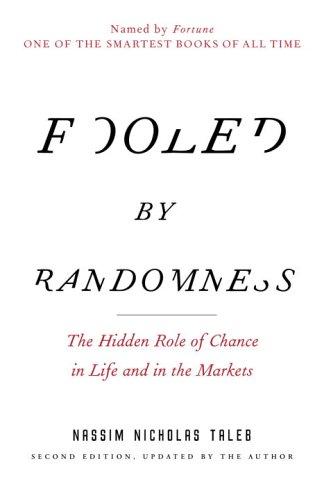

Luck, survivorship bias and the danger of confusing outcomes with good decisions.
Synopsis
Fooled by Randomness examines our tendency to mistake luck for skill, patterns for causes and successful outcomes for evidence of good decision-making.
Taleb’s central argument is that people routinely underestimate the role of chance, particularly in finance, business and careers. When someone succeeds, we construct a convincing story explaining why their intelligence, discipline or strategy produced the result. We pay much less attention to the many people who behaved similarly but failed.
This creates survivorship bias. We study the visible winners while ignoring the much larger population that disappeared from view.
Taleb is particularly sceptical of traders and executives who build reputations during favourable market conditions. A strategy may appear brilliant for years while quietly accumulating risks that only become visible when an unlikely event occurs.
Why I Read It
I read Fooled by Randomness because it sits naturally alongside my interest in systems thinking, complexity and decision-making under uncertainty.
Product management and operational planning often encourage people to explain results too confidently. A successful launch becomes evidence that the strategy was correct. A missed target becomes evidence that someone made a mistake. In reality, outcomes are produced by a mixture of decisions, system conditions, timing and chance.
I wanted a better framework for distinguishing between a good decision and a good outcome. They are related, but they are not the same thing.
Key Learnings
The most important lesson is that outcomes cannot be used as a simple measure of decision quality.
A sensible decision can produce a poor outcome because of bad luck. A reckless decision can produce an excellent outcome because of good luck. Judging only by the result creates a dangerous form of learning, because it rewards behaviour that happened to work rather than behaviour that was robust.
Taleb also explains survivorship bias particularly well. We hear from successful entrepreneurs, investors and leaders because they survived. Their stories are visible, repeatable and usually presented as transferable lessons. The people who used similar approaches and failed rarely write the books or appear on conference stages.
Another useful idea is that people prefer stories to probability. We want events to have clear causes, identifiable heroes and lessons that can be applied next time. Randomness is uncomfortable because it suggests that some events cannot be explained neatly and that expertise has limits.
This is relevant to product management. Teams frequently create narratives around performance metrics without asking whether the observed change is meaningful, whether it is normal variation or whether external conditions changed at the same time.
The book also reinforces the importance of designing for survival rather than prediction. You may not be able to predict every failure, market shift or operational disruption, but you can avoid strategies where one unexpected event destroys everything.
Review
Taleb is provocative, repetitive and occasionally more interested in attacking people he dislikes than developing the argument. His tone can become distracting, particularly when he dismisses entire professions or groups of people.
However, the central ideas are powerful.
The distinction between luck and skill sounds obvious, but it is regularly ignored in business. Organisations reward visible outcomes, promote people associated with successful projects and copy practices from successful companies without properly considering the conditions that produced those results.
The book did not convince me that expertise is meaningless. It convinced me that expertise should be judged across repeated decisions, different conditions and sufficiently long periods of time.
That is a more demanding standard than simply asking who won.
Rating
4/5
An important book about uncertainty, survivorship bias and the danger of constructing confident explanations from limited evidence. The argument is stronger than the delivery, but the central lesson is difficult to forget: sometimes success is evidence of good judgement, and sometimes it is simply what randomness looks like from the winner’s perspective.