Work as Imagined vs Work as Done: What Porridge Reveals About Processes
Porridge as a study of Work as Imagined versus Work as Done: why experienced people adapt the process, and why automating the official version fails.
8 min read →Article
Social Identity Theory and Senge's mental models, via Alf Garnett: why each department's partial view of the business feels like the whole system.
By Richard Faint · 21 July 2026 · 6 min read
Last updated
On screen
Departments often mistake their partial view of an organisation for the whole system. Social identity and mental models explain why teams defend local objectives and dismiss other perspectives, making better decisions depend on exposing assumptions and widening the boundary of discussion.
“It stands to reason…”
The title is a sitcom catchphrase. The subject is organisational tribalism: Social Identity Theory, Senge’s mental models, and why every department mistakes its own partial view for the whole system.
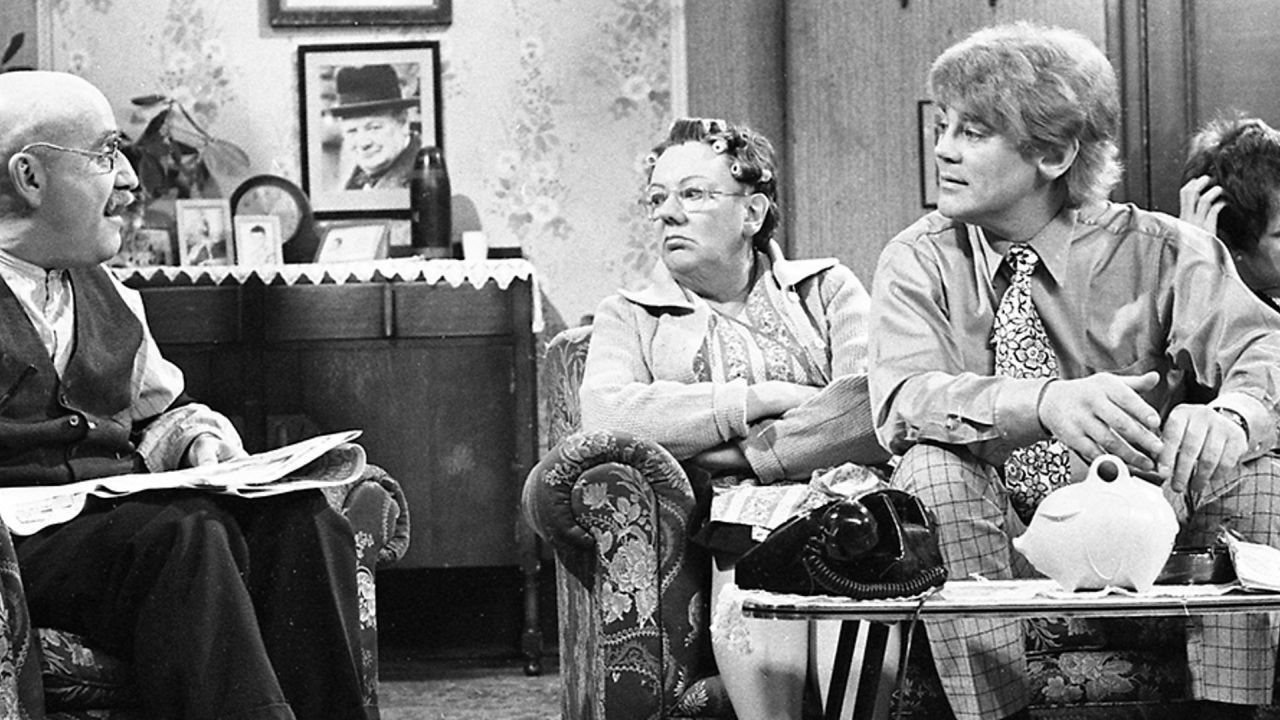
Few sitcoms have aged as awkwardly as Till Death Us Do Part. First broadcast in 1965, Johnny Speight’s creation is remembered as much for the controversy as for its comedy. Warren Mitchell’s portrayal of Alf Garnett remains one of television’s most recognisable characterisations, yet the programme provokes debate because its satire was so convincing that many viewers misunderstood it. Speight intended Alf to be the object of ridicule rather than admiration, exposing prejudice, tribalism and closed-mindedness through comedy. Ironically, many people watched exactly the same programme and concluded that Alf was the only character talking sense. That misunderstanding says as much about human nature as the sitcom itself.
Alf never approached an argument with an open mind. Whether the subject was politics, television, football or family life, the conclusion was decided before the discussion had begun. His favourite phrase, “It stands to reason,” introduced arguments that were anything but reasonable, while his long-suffering son-in-law Mike Rawlins could not finish a sentence before being dismissed as “that Scouse…” Mike’s evidence was irrelevant because, in Alf’s eyes, he belonged to the wrong tribe - the socially liberal. Once someone’s identity placed them on the other side, whatever they said was wrong.
Football provided some of the programme’s funniest examples of this instinct. In Up the Hammers, Alf takes his infant grandson Michael to Upton Park, convinced that one day the boy will wear the famous claret and blue shirt alongside heroes such as Bobby Moore. The humour lies in the absurd certainty. Alf has absolutely no evidence that his grandson will become a footballer, yet evidence is beside the point. West Ham is not simply a football club to Alf, it is his identity, and identity has a remarkable habit of reshaping how we interpret reality.
Most of us can recognise this because football encourages exactly this kind of behaviour,supporters watch the same game and reach different conclusions about refereeing decisions. The officials always seem harsher on your club. It is not a deliberate attempt to ignore the evidence, rather loyalty changes the way the evidence is interpreted.
Psychologists Tajfel and Turner described this as Social Identity Theory, arguing that people rapidly form attachments to groups and almost immediately begin favouring those groups over others. Once we identify ourselves as members of a team, we instinctively seek information that confirms our group’s competence while discounting evidence that challenges it. Football supporters understand this intuitively because supporting a club is rarely the result of careful analysis. Few supporters look at all the evidence and conclude that one club deserves their loyalty, if they did Hartlepool United would have more fans! Most support the team they inherited from family, the club nearest where they grew up, or the one that captured their imagination as children.
It is tempting to believe that businesses operate differently and make rational decisions. In reality, the same psychological forces appear every day:-
None of these perspectives is irrational, each reflects the reality experienced by the people inside that department. The problem begins when those local realities become the only reality that matters.
Senge explored this in The Fifth Discipline through the concept of mental models: the deeply held assumptions, beliefs and habits of thought that shape how people interpret the world around them. These models help us make sense of complexity, but they create blind spots. Each department develops a coherent view of the organisation, based on the information it sees, the pressures it faces and the outcomes it is measured against. The danger arises when that partial view is mistaken for the whole system. Sales, Operations, Finance and Technology may each be acting rationally within their own frame of reference while collectively producing decisions that make little sense for the organisation. For those of us in Product, this is a central challenge. The role is not simply to represent another departmental perspective, but to expose the assumptions behind competing views, connect them across the wider system and help the organisation reach a more complete understanding of the problem it is trying to solve.
Different responsibilities make different evidence and costs visible.
A customer needs the complete service to work.
Sees loading progress and pressure to finish preparing orders.
Sees waiting drivers and delivery windows at risk.
Sees operating costs and pressure to control spending.
Expose the assumptions and trade-offs behind each local view before choosing an intervention.
The branches are perspectives on one system, not separate systems. A locally sensible target can transfer a cost or delay into another department.
This is why Till Death Us Do Part is an effective metaphor for organisational behaviour. Alf does not reject Mike’s ideas because he has carefully evaluated them and found them wanting, he rejects them because they come from Mike. His identity determines which arguments deserve consideration before the arguments themselves are even heard. Organisations have their own versions of “that Scouse…” Ideas from Sales are dismissed because “they don’t understand operations”; suggestions from Finance are ignored because “they only care about costs”; and Technology proposals are resisted because “IT doesn’t understand the real world”. The source of the argument becomes more important than the evidence supporting it. The question is no longer, “Is this right for the organisation?” but, “Whose side are you on?”
Breaking that pattern requires more than another reorganisation or another set of KPIs. Leaders need to create a shared understanding of success that crosses departmental boundaries. Measures should reward end-to-end outcomes rather than local optimisation, while governance should force competing functions to examine the same evidence and make their assumptions explicit. Product teams can support this by mapping the complete system, distinguishing observed facts from departmental interpretations, and testing whether apparently conflicting views are actually responses to different incentives. Even the simple habit of asking, “What outcome is best for the organisation?” before asking, “Which department suggested this?” can help separate evidence from tribal loyalty. Johnny Speight created Alf Garnett to expose the dangers of tribal thinking, yet one of the programme’s greatest achievements was revealing how easily all of us fall into exactly the same trap. We naturally defend the groups that define us, whether those groups are football clubs, political parties or departments within an organisation. Alf’s unwavering devotion to West Ham is amusing because it is so exaggerated, but the instinct behind it is entirely recognisable.
The real challenge for leaders is not eliminating loyalty, because loyalty creates commitment, resilience and pride. The challenge is ensuring that loyalty never becomes more important than evidence. The next time someone from another department challenges one of your assumptions, it is worth pausing before dismissing the idea. Otherwise, we risk becoming organisational versions of Alf, entirely certain of our conclusions, suspicious of anyone from the wrong tribe and insisting that our partial view of the world simply “stands to reason”.
Try it interactively. Open the departmental optimisation simulation on its own page → — full-width, with a walkthrough of what each control does.