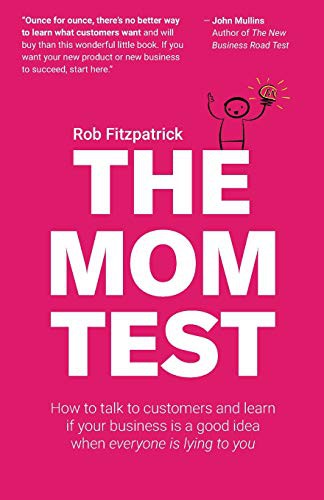

Better customer conversations through evidence, not compliments.
Synopsis
The Mom Test is a short, practical guide to conducting better customer conversations. Its central argument is that customers frequently give misleading feedback, not because they are deliberately dishonest, but because people naturally try to be polite, encouraging and helpful.
The title refers to a simple test: even your mum will tell you that your business idea sounds good because she does not want to hurt your feelings. A useful customer conversation must therefore be structured so that even someone who wants to be supportive cannot accidentally give you bad information.
Rather than asking customers whether they like an idea or whether they would use a proposed product, Rob Fitzpatrick recommends asking about their existing behaviour, current problems and previous attempts to solve them. The objective is not to collect praise. It is to uncover evidence.
The book is particularly relevant to founders and Product Managers because it explains how easily customer discovery can become disguised salesmanship. Once we start describing a solution, we influence the answer and make it increasingly difficult to distinguish genuine demand from politeness.
Why I Read It
Customer conversations are a fundamental part of Product Management, but they are also surprisingly difficult to conduct well.
It is very easy to enter a discovery conversation with an existing hypothesis and then unconsciously look for evidence that supports it. This becomes especially dangerous when customers are already familiar with you, want to maintain a good commercial relationship or believe that giving positive feedback is the helpful response.
I read The Mom Test because I wanted a more disciplined way of separating genuine customer evidence from compliments, opinions and speculative feature requests. This is particularly important when working on complex operational software. Customers are often very good at describing what frustrates them, but their suggested solution is inevitably shaped by the system and processes they already know.
The challenge for Product is to understand the underlying problem without simply building the first feature that somebody requests.
Key Takeaways
Ask About the Past, Not the Future
Questions about future behaviour produce unreliable answers.
Customers may genuinely believe that they would use a product, change a process or pay for a service. However, intentions are cheap. Past behaviour provides stronger evidence because it shows what the customer has already considered important enough to spend time, money or effort addressing.
Instead of asking:
Would you use a tool that automatically optimised your transport plan?
A stronger conversation would explore:
Tell me about the last time the transport plan had to be rebuilt.
What caused it?
How did the team respond?
How much time did it take?
What happened operationally as a result?
The second set of questions uncovers the actual process, frequency, impact and current workaround. It provides evidence without requiring the customer to predict how they might behave in an imagined future.
Talk About Their Problem, Not Your Product
Once you begin explaining your solution, the conversation changes.
The customer is no longer describing their world. They are reacting to your presentation. They may compliment the idea, suggest additional functionality or try to demonstrate enthusiasm, but none of this necessarily proves that the underlying problem is important.
Good discovery therefore requires restraint. The Product Manager should speak less, listen more and resist the temptation to correct, explain or sell.
The objective is not to convince the customer that the solution is good. It is to determine whether the problem is real.
Compliments Are Not Evidence
Statements such as “That sounds brilliant” or “We would definitely use that” feel valuable because they validate the work already done. In practice, they contain very little information.
Fitzpatrick identifies compliments, vague claims and hypothetical promises as forms of bad data. They feel encouraging but do not provide reliable evidence for a product decision.
Evidence is more concrete:
- The customer has repeatedly experienced the problem.
- The problem has measurable operational consequences.
- They currently use a workaround.
- They have already allocated time, money or people to solving it.
- They are prepared to make a meaningful commitment.
The distinction is between somebody saying that a problem matters and behaving as though it matters.
Feature Requests Need to Be Investigated
Customers will often describe a problem in the form of a solution:
We need another field on this screen.
This should automatically generate a report.
The system needs an additional status.
These requests should not be ignored, but neither should they be accepted at face value. The important question is what the customer is trying to achieve.
A request for another status may reveal a lack of operational visibility. A new report may indicate that users cannot trust the existing workflow. A request for automation may expose a repetitive manual process, but it could also be masking a badly designed process that should not exist at all.
The feature request is the beginning of discovery, not the conclusion.
Look for Commitment and Advancement
A productive customer conversation should create some form of movement.
That does not necessarily mean securing a sale. It might involve gaining access to operational data, arranging a conversation with another stakeholder, observing the current process or agreeing to test a prototype.
Fitzpatrick describes this as commitment and advancement. Genuine interest normally requires the customer to contribute something meaningful, whether that is time, access, reputation or money.
Without that commitment, positive feedback may simply represent a pleasant conversation.
Discovery Can Still Produce the Answer You Wanted
The techniques in The Mom Test reduce bias, but they cannot remove it completely.
A Product Manager can ask apparently sensible questions while selectively interpreting the answers. There remains a temptation to give greater weight to supportive comments and explain away contradictory evidence.
Good discovery therefore requires more than better interview questions. It also requires clear hypotheses, consistent notes, multiple participants and an explicit method for deciding what the evidence means.
The interview is only the data-collection stage. The quality of the decision depends on what happens afterwards.
Review
The Mom Test is one of the more useful Product Management books because it is short, focused and immediately applicable. It does not attempt to create an enormous framework or reposition basic common sense as a revolutionary new management philosophy.
Its main ideas are not especially complicated. Ask about real behaviour, avoid pitching, investigate problems properly and do not treat compliments as validation. However, these principles are difficult to apply consistently because they run against normal conversational instincts.
When somebody praises an idea, we want to believe them. When they misunderstand the proposed solution, we want to explain it. When they suggest a feature, we want to capture it as a requirement. The book is valuable because it provides a practical discipline for resisting those impulses.
Some of its examples are naturally focused on startups and early-stage product validation. In an established B2B environment, customer relationships, contractual commitments and existing product architecture make discovery more complicated. You cannot always avoid discussing the solution, particularly when investigating changes to an existing system.
The underlying lesson still holds. The purpose of discovery is not to prove that our idea is correct. It is to understand the customer’s reality well enough to make a better decision.
That sounds obvious, but much of what organisations call customer discovery is still little more than presenting an idea and asking whether people like it.
Rating
4.5 out of 5
A concise and highly practical book that should be read by anyone conducting customer interviews or making product decisions. Its ideas are straightforward, but applying them properly would prevent a considerable amount of wasted development.