
Shared stories, human cooperation and the systems that built civilisation.
Synopsis
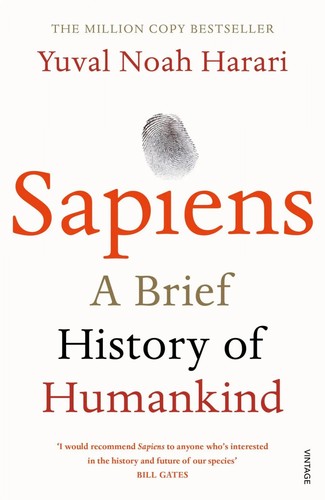
Sapiens is Yuval Noah Harari’s broad history of humanity, tracing the development of Homo sapiens through the Cognitive Revolution, the Agricultural Revolution, the unification of humankind and the Scientific Revolution.
Harari’s central argument is that humans became dominant because of our ability to cooperate flexibly in very large groups.
This cooperation depends upon shared stories. Nations, religions, currencies, laws and companies exist because enough people collectively believe in them. Although these institutions are created by humans, their consequences are very real.
Why I Read It
I read Sapiens because it combines history, science, economics and philosophy into a single account of how human societies developed.
I was particularly interested in Harari’s argument that large systems are held together by shared narratives. This connects closely with my interest in systems thinking, organisations and the way institutions coordinate people who may never meet one another.
I enjoyed the book enough to buy the graphic novel adaptations for my children. They present many of the same ideas in a more accessible and entertaining format.
Key Takeaways
The strongest idea in the book is that humans can organise at scale because we believe in common stories.
Money, companies and nations are not physical realities in the same way as mountains or animals, but they allow millions of strangers to coordinate their actions.
Harari’s discussion of the Agricultural Revolution is also memorable. Farming increased the overall human population, but it may have made life harder for many individual people through longer working hours, poorer diets and greater inequality.
It is a useful systems lesson: a change can improve one measure while making the wider outcome worse.
The book also shows how institutions become self-reinforcing. Once laws, infrastructure and social expectations develop around a system, alternatives become increasingly difficult to imagine.
Review
Sapiens is ambitious, readable and full of memorable ideas. Harari is particularly effective at connecting subjects that are usually considered separately.
Its weakness is that complicated historical debates are sometimes compressed into confident and simplified explanations. The arguments are often persuasive, but they should be treated as useful models rather than definitive conclusions.
Despite this, the book succeeds because it changes how familiar institutions are understood. Money becomes a coordination technology, companies become legally supported stories, and history becomes a process shaped by chance, power and feedback rather than inevitable progress.
Who Is It For?
This is for readers interested in history, society, systems thinking and big ideas.
It is particularly suitable for people who want an accessible overview rather than a detailed academic history.
Rating
4.5 out of 5
An ambitious and thought-provoking book whose central argument about shared stories and large-scale cooperation remains convincing long after finishing it.