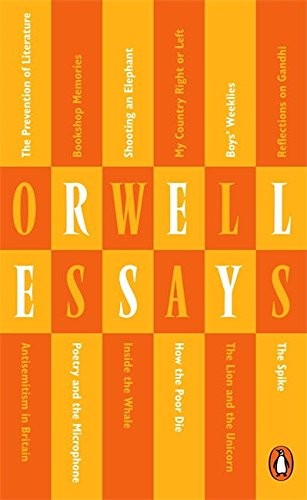

Politics, class, power and the value of clear language.
Synopsis
George Orwell is best known for Animal Farm and Nineteen Eighty-Four, but many of his strongest ideas appear in his essays. This collection covers politics, class, language, imperialism, literature and ordinary English life.
Essays such as Shooting an Elephant, A Hanging, Why I Write and Politics and the English Language show Orwell at his best: beginning with something specific and using it to expose a wider truth about power, society or human behaviour.
Why I Read It
I have read a lot of Orwell over the years, including many of these essays before. I therefore read this collection less as an introduction and more as a reminder of why his writing remains so influential.
I was particularly interested in returning to his ideas about politics, language and class, but also in reconsidering his method. Orwell often starts with a personal experience, a book, a newspaper or an everyday habit and turns it into a much larger argument. That approach is relevant to the type of essays I am trying to write myself.
Key Takeaways
Clear language supports clear thinking
Orwell argues that vague and inflated language allows people to avoid saying what they really mean. This remains particularly relevant in politics and organisations, where uncomfortable decisions are often hidden behind abstract language.
People are not dismissed; there is a “resource realignment”. A product has not failed; it has encountered “market headwinds”. The language creates distance between the decision and its consequences.
Power can constrain the powerful
In Shooting an Elephant, Orwell appears to hold authority as a colonial police officer, but he is also trapped by the expectations of the crowd watching him.
He shoots the elephant not because he believes it is necessary, but because the role he occupies demands a performance of certainty and control. The essay shows how systems can constrain the person who appears to be in charge.
Experience should come before ideology
Orwell had strong political beliefs, but he remained willing to criticise people on his own side. He distrusted tribal loyalty when it required people to ignore evidence or excuse hypocrisy.
His writing is strongest when he describes what he actually sees rather than forcing reality to fit a political theory.
Ordinary culture reveals deeper values
Orwell writes seriously about newspapers, popular fiction, pubs, food and English habits because everyday culture reveals how a society thinks.
This is one of the most useful lessons for my own writing. Popular culture is not merely a source of entertaining analogies. It often contains assumptions about work, authority, class and leadership that are worth examining.
Clarity does not guarantee correctness
Orwell is not always right, and some of his arguments have aged poorly. However, he usually states his position clearly enough for the reader to understand and challenge it.
That intellectual exposure is part of what makes the essays valuable. The assumptions and reasoning are visible rather than hidden behind academic language or excessive qualification.
Who Is It For?
This collection is for readers interested in politics, language, class, power and clear writing. It is particularly worthwhile for anyone who knows Orwell mainly through Animal Farm and Nineteen Eighty-Four and wants to understand the wider range of his thinking.
Review
The collection shows that Orwell was far more than the author of two famous political novels. He was an observant and often uncomfortable writer who was willing to examine the weaknesses of his own political allies as closely as those of his opponents.
Not every essay has aged equally well, and some depend heavily on the literary and political arguments of their period. The collection can also feel repetitive because Orwell repeatedly returns to the same concerns: dishonesty, class, power and the corruption of language.
However, the strongest essays remain exceptional. Shooting an Elephant explores how authority becomes a trap. A Hanging turns an execution into a devastating reflection on the value of an individual life. Why I Write is remarkably honest about ambition and political motivation. Politics and the English Language remains relevant wherever vague language is used to obscure weak thinking or avoid responsibility.
Reading the collection was therefore less about discovering a new Orwell than reminding myself why I had valued his work in the first place. What stands out is his commitment to clarity. He believed that writing should reveal rather than obscure and that intellectual honesty required people to describe the world they actually saw rather than the world their ideology told them ought to exist.
Rating: 4.5/5