
Information, power and the networks shaping the age of AI.
Synopsis
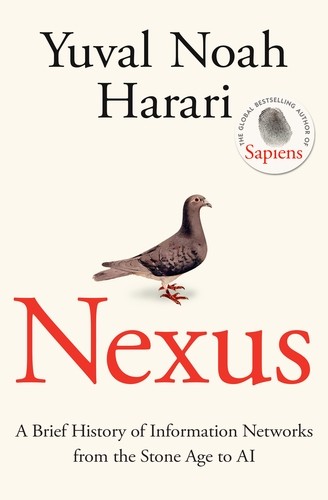
Nexus is Yuval Noah Harari’s history of information networks, tracing their development from oral stories and religious texts through bureaucracy, newspapers, mass media and modern artificial intelligence.
His central argument is that information is not the same thing as truth. Information primarily connects people, coordinates behaviour and creates order, even when the stories holding the network together are inaccurate or entirely fictional.
The final part of the book turns to AI. Previous information technologies mainly transmitted or stored human ideas, whereas AI can increasingly create content, make decisions and communicate without direct human involvement. Harari argues that this represents a fundamental change in who, or what, participates in our information networks.
Why I Read It
I had already read Sapiens and was interested in seeing Harari apply his broad historical approach to AI.
Most books about artificial intelligence concentrate on the technology itself. Nexus promised something different: an examination of AI as the latest stage in humanity’s much longer attempt to organise information, coordinate large groups and exercise power.
That felt particularly relevant to my interests in systems thinking and technology. AI does not operate separately from organisations and institutions. It becomes part of the networks through which decisions are made, information is filtered and authority is exercised.
Key Takeaways
The book’s strongest idea is that more information does not automatically produce more truth or wisdom.
Large information systems often succeed because they create a shared version of reality, not because that version is objectively correct. Religions, states, corporations and political movements can all coordinate millions of people through common stories, classifications and procedures.
Harari also distinguishes between democratic and totalitarian information networks. Democratic systems distribute information and retain mechanisms for correcting mistakes, while totalitarian systems centralise information and suppress challenges.
This makes self-correction one of the most important characteristics of a healthy system.
The sections on bureaucracy are particularly useful. Bureaucracies make complex societies possible by dividing reality into categories, forms, records and procedures. However, the model can gradually become more important than the world it is supposed to represent.
This is recognisable in almost any large organisation. Once a metric, workflow or database field becomes embedded, people begin managing the representation rather than the underlying problem.
The AI argument follows naturally from this. Algorithms already influence what information people see, but increasingly they will also create information, interpret it and act upon it.
Harari’s concern is therefore not simply that AI might become highly intelligent. It is that non-human agents could begin shaping the conversations, institutions and stories through which society understands itself.
Review
Nexus is at its best when Harari connects apparently separate historical developments into a clear argument about information, power and institutional design.
Like Sapiens, it is ambitious, accessible and full of ideas that encourage the reader to reconsider familiar events from a different perspective.
Its weakness is also familiar. Harari sometimes compresses complicated historical debates into a single, elegant narrative. The argument is persuasive at the level of systems and patterns, but individual examples can feel selected to support a conclusion that has already been reached.
The later chapters are also more speculative and alarmist than the historical sections. His concerns about AI are legitimate, but the book occasionally moves too quickly from identifying a possible risk to presenting it as the likely direction of travel.
Despite that, Nexus provides a useful way of thinking about AI. It moves the discussion away from individual tools and asks the more important question: what happens when artificial agents become active participants in the information networks that coordinate society?
Who Is It For?
This is for readers interested in history, systems thinking, technology and the wider social implications of AI.
It will particularly appeal to people who enjoyed Sapiens, although readers looking for a detailed technical explanation of artificial intelligence may find the book too broad.
Rating
4 out of 5
An intelligent and highly readable history of information systems. It is strongest when examining networks, bureaucracy and institutional self-correction, and slightly less convincing when predicting the future of AI.