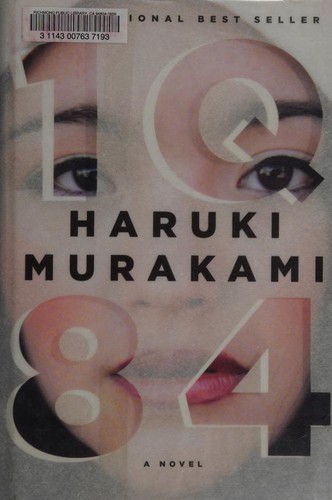

Parallel worlds, private realities and the danger of accepting the impossible.
Synopsis
1Q84 follows two characters, Aomame and Tengo, whose lives gradually converge within a subtly altered version of Tokyo in 1984.
Aomame first realises that something has changed when she notices details that do not fit her memory of the world. Police uniforms are different, historical events appear to have unfolded another way, and two moons hang in the sky. She begins calling this altered reality “1Q84”, with the Q standing for a question mark.
Tengo, meanwhile, is drawn into rewriting a strange manuscript called Air Chrysalis. The novel describes mysterious beings known as the Little People and a world that increasingly seems less fictional than it first appeared.
The story moves between their perspectives, combining romance, crime, religious cults, surveillance, loneliness and the gradual breakdown of any clear boundary between objective reality and personal belief.
Why I Read It
I have read Murakami before and enjoy the way he allows ordinary life and the surreal to exist alongside one another without insisting on a clear explanation.
I was also interested in the book’s scale. 1Q84 is not a short or tightly plotted novel. It develops slowly, repeats ideas and spends a great deal of time inside the routines and private thoughts of its characters. That requires more patience than many contemporary novels, but it also allows the alternative world to emerge almost imperceptibly.
Rather than transporting the characters into an obviously different universe, Murakami alters small details and leaves them to decide whether the world has changed or whether they have.
What Stayed With Me
The most interesting idea is that reality depends partly on shared agreement.
Aomame knows she is in a different world because her memories conflict with the evidence around her. Everyone else appears to accept the altered history as normal. This creates a difficult question: when an individual’s experience contradicts the accepted version of events, which should be trusted?
The novel also explores how systems of belief can manufacture their own reality. Religious organisations, political movements and closed communities do not simply interpret the world. They create language, rules and narratives that determine what their members are able to see.
This is not entirely different from organisations. A company can describe a failing project as being “on track”, an overloaded team as “resilient”, or a structural problem as a temporary delivery issue. Once enough people adopt the language, the description begins to function as reality, even when the evidence points elsewhere.
Murakami’s two moons are an obvious signal that something is wrong. In real organisations, the signs are usually less dramatic.
Review
1Q84 is strange, slow and deliberately repetitive. Some sections are absorbing, while others feel longer than they need to be. However, the repetition also contributes to the atmosphere. Daily routines become anchors as the characters’ world grows less reliable.
It is not a book that rewards rushing. Its strength lies less in individual plot developments than in the cumulative feeling that reality has shifted and may never return to its original position.
Having finished it, I find its treatment of belief, isolation and the systems people construct to make uncertain worlds feel coherent more memorable than any single plot development.